A/B Testing at Scale: Feature Flags and Statistics
Run A/B tests at scale with feature flags, multivariate experiments, user segmentation and sound statistics. Avoid common mistakes as experiment volume grows.

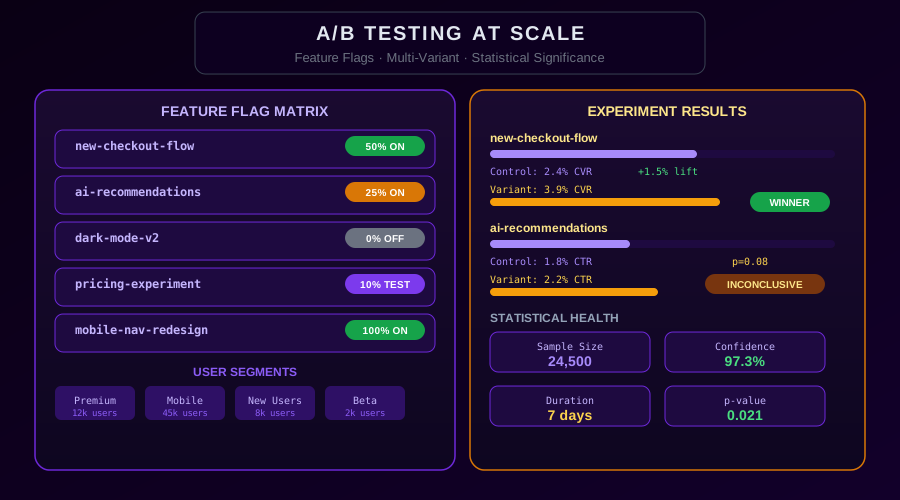
Running many experiments at once needs feature flags, analytics, and a sound statistical process.
The Architecture of a Scale A/B Testing Platform
A production-grade experiment platform has four components.
Feature Flag Service — Stores experiment configurations, manages user segment assignments, and serves flag evaluations with sub-millisecond latency.
Event Tracking Pipeline — Every user action that could be a success metric must be tracked and streamed to your analytics system via Kafka or Kinesis.
Experiment Analysis Engine — Reads from your event pipeline and computes statistical metrics, handling sample size calculations, significance testing, and confidence intervals.
Experiment Management UI — A self-service interface for product managers and engineers to create experiments without engineering support for every test.
Feature Flag Implementation
import hashlib
class FeatureFlagService:
def get_variation(self, experiment_id: str, user_id: str,
traffic_allocation: int = 50) -> str:
hash_val = int(hashlib.sha256(
f"{user_id}:{experiment_id}".encode()
).hexdigest(), 16) % 100
if hash_val >= traffic_allocation:
return "control"
bucket = int(hashlib.sha256(
f"{user_id}:{experiment_id}:bucket".encode()
).hexdigest(), 16) % 2
return "variant_b" if bucket == 1 else "variant_a"
Multi-Variant Testing
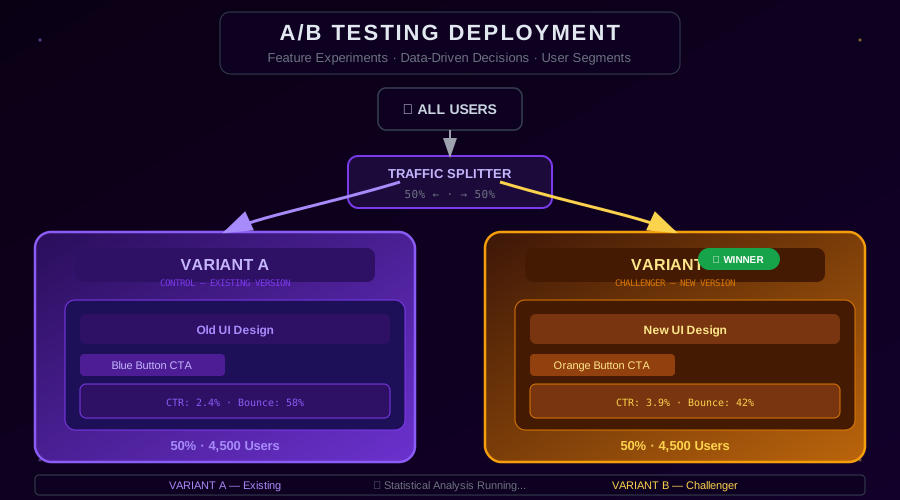
MVT compares three or more variants but requires proportionally more traffic to maintain statistical power.
experiment:
id: "pricing-page-mvt"
variants:
- id: control
weight: 25
- id: simplified_tiers
weight: 25
- id: per_seat_pricing
weight: 25
- id: usage_based
weight: 25
primary_metric: "trial_to_paid_conversion"
minimum_detectable_effect: 0.05
statistical_significance: 0.95
User Segmentation
Running experiments on your entire user base is wasteful when only specific segments are relevant.
segments = {
"new_users": lambda u: u.created_days_ago < 30,
"premium_users": lambda u: u.plan == "premium",
"mobile_users": lambda u: u.device_type == "mobile",
"power_users": lambda u: u.sessions_last_30_days > 20,
}
Geographic segmentation is especially useful for validating features in specific markets before global rollout.
Bayesian vs Frequentist Statistics
Frequentist Approach — Uses p-values and requires pre-determined sample sizes. The conventional threshold is p < 0.05 for statistical significance.
from scipy import stats
def frequentist_test(control_conv, control_n, variant_conv, variant_n):
control_rate = control_conv / control_n
variant_rate = variant_conv / variant_n
pooled = (control_conv + variant_conv) / (control_n + variant_n)
se = (pooled * (1 - pooled) * (1/control_n + 1/variant_n)) ** 0.5
z = (variant_rate - control_rate) / se
p_value = 2 * (1 - stats.norm.cdf(abs(z)))
return {"lift": (variant_rate - control_rate) / control_rate,
"p_value": p_value,
"significant": p_value < 0.05}
Bayesian Approach — Computes the probability that the variant is better than control. More intuitive and allows continuous monitoring without inflating false positive rates.
import numpy as np
def bayesian_test(control_conv, control_n, variant_conv, variant_n):
control_post = np.random.beta(control_conv + 1,
control_n - control_conv + 1, 100000)
variant_post = np.random.beta(variant_conv + 1,
variant_n - variant_conv + 1, 100000)
return {
"prob_variant_better": (variant_post > control_post).mean(),
"expected_lift": (variant_post - control_post).mean(),
}
Running Multiple Experiments Safely
Mutual Exclusion Groups — Experiments that modify the same user journey must be mutually exclusive. A user cannot be in two checkout experiments simultaneously.
exclusion_groups:
- name: "checkout_experiments"
experiments:
- checkout-button-color
- checkout-form-layout
policy: mutually_exclusive
Experiment Namespacing — Separate experiment domains so users in one namespace are not assigned to experiments in another. This prevents interaction effects between unrelated experiments.
Key Metrics to Track
For every experiment, track three metric categories.
Primary metric — The business outcome you are trying to improve (conversion rate, sign-ups, revenue per user).
Secondary metrics — Supporting signals that provide context (time on page, session depth, feature adoption).
Guardrail metrics — Metrics that must not degrade regardless of primary metric improvement (page load time, error rate, support ticket volume).
Avoiding Common Mistakes at Scale
P-hacking and peeking — Do not stop experiments early because results look good. Establish sample sizes before launching and run to completion. Set up weekly checkpoints rather than continuous monitoring.
Simpson's Paradox — When aggregating across segments, the overall result can reverse what you see in individual segments. Always analyze results by key segments alongside the aggregate.
Experiment debt — Old experiments that never get cleaned up accumulate as technical debt. Establish a maximum experiment lifespan policy (e.g., 90 days) and automate cleanup of expired flags.
Conclusion
Building A/B testing at scale requires treating experiments as a first-class engineering concern. By investing in a proper feature flag platform, robust analytics pipeline, and rigorous statistical methodology, you create an organization capable of learning from every product change and continuously improving based on evidence rather than intuition.
Related: A/B Testing Deployment Basics | Shadow Deployment for Risk-Free Testing | Canary Deployment for gradually rolling out the winning variant
From the team at Nife
Deploy your next app in minutes, not days.
Nife is a multi-cloud edge platform that lets you deploy, scale, and manage applications globally without the infrastructure headache.