Building Scalable Code Execution Platforms Using Judge0
Learn how to build secure and scalable code execution platforms using Judge0. Explore deployment, API integration, multi-language support, and production-ready execution workflows

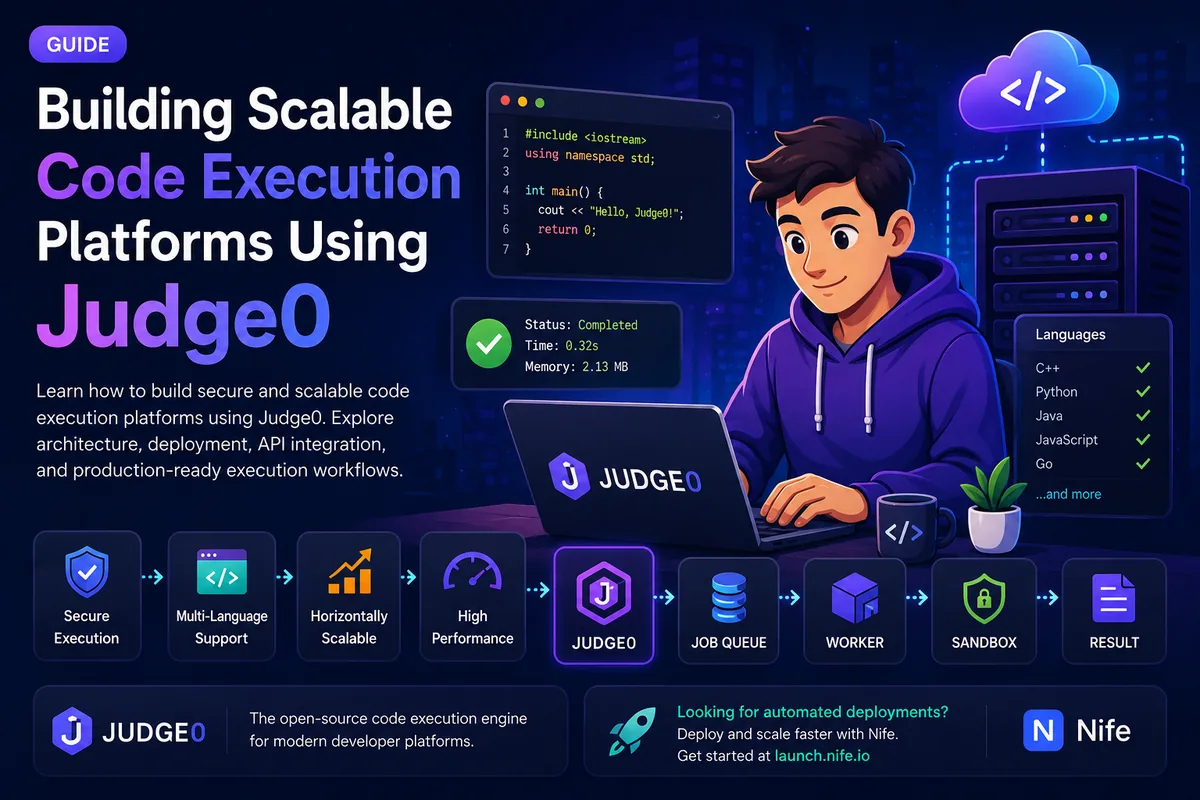
Modern applications increasingly require the ability to execute user-submitted code securely and efficiently. Coding assessment platforms, online learning systems, competitive programming websites, AI-powered developer tools, and technical interview platforms all depend on reliable code execution infrastructure.
While executing code may seem straightforward, running untrusted user programs in production environments introduces significant challenges. Teams must manage multiple language runtimes, isolate execution environments, enforce resource limits, process concurrent submissions, and maintain platform security and reliability at scale.
Building and maintaining this infrastructure from scratch requires substantial engineering effort. Organizations need a solution that can handle code execution securely while allowing development teams to focus on product innovation rather than runtime management.
Judge0 addresses these challenges by providing a production-ready code execution engine that supports multiple programming languages, secure execution environments, and scalable processing workflows. Instead of building a custom compiler and execution backend, teams can leverage Judge0 as the core execution layer of a scalable code execution platform.
Table of Contents
- The Challenge of Running User Code
- What is Judge0?
- How Judge0 Works
- Judge0 vs Building Your Own Compiler Service
- Step 1: Deploy Judge0 with Docker
- Step 2: Submit Your First Program
- Step 3: Retrieve Execution Results
- Supported Languages
- Scaling Judge0 for Production
- Security Best Practices
- Before vs After: Judge0 Adoption
- Troubleshooting Common Issues
- FAQ
- Conclusion
The Challenge of Running User Code
Executing user-submitted code sounds simple until real-world requirements appear.
A production-ready code execution platform must:
- Support multiple programming languages
- Isolate untrusted code
- Prevent resource abuse
- Handle thousands of submissions
- Scale reliably
- Return execution results quickly
Building all of this internally requires significant engineering effort.
How Judge0 Fits Into the Architecture
Judge0 is an open-source code execution system that provides a REST API for compiling and running source code.
Developers can integrate Judge0 into:
- Coding assessment platforms
- Online learning systems
- Competitive programming websites
- Technical interview platforms
- Developer sandboxes
Judge0 supports dozens of programming languages and can be deployed using Docker.
How Judge0 Works
User
↓
Application
↓
Judge0 API
↓
Job Queue
↓
Worker
↓
Sandbox
↓
Execution Result
The application sends source code to Judge0.
Judge0 queues the request, executes it in an isolated environment, captures the output, and returns the result through its API.
Judge0 vs Building Your Own Compiler Service
| Feature | Judge0 | Custom Solution |
|---|---|---|
| Multi-language support | Built-in | Manual setup |
| Security controls | Available | Must build |
| API layer | Included | Must develop |
| Docker deployment | Supported | Custom |
| Maintenance effort | Lower | Higher |
For most teams, Judge0 dramatically reduces development complexity.
Step 1: Deploy Judge0 with Docker
Prerequisites
- Docker
- Docker Compose
Verify installation:
docker --version
docker compose version
Clone the repository:
git clone https://github.com/judge0/judge0.git
cd judge0
Start Judge0:
docker compose up -d
Verify:
docker ps
Step 2: Submit Your First Program
Example Python submission:
curl -X POST http://localhost:2358/submissions -H "Content-Type: application/json" -d '{
"source_code":"print(\"Hello World\")",
"language_id":71
}'
Response:
{
"token":"submission-token"
}
Step 3: Retrieve Execution Results
curl http://localhost:2358/submissions/<token>
Example response:
{
"stdout":"Hello World",
"stderr":null,
"status":{
"description":"Accepted"
}
}
Supported Languages
Judge0 supports numerous languages including:
- Python
- Java
- JavaScript
- C
- C++
- Go
- Rust
- Ruby
This makes it suitable for educational and assessment platforms.
Scaling Judge0 for Production
As submission volume increases, Judge0 can scale horizontally.
API
|
Queue
|
+---- Worker 1
+---- Worker 2
+---- Worker 3
Production recommendations:
- Use multiple workers
- Monitor queue depth
- Add load balancing
- Containerize deployments
- Deploy on Kubernetes when needed
Security Best Practices
When executing user code:
- Use isolated containers
- Restrict network access
- Apply CPU limits
- Apply memory limits
- Monitor execution activity
- Set execution timeouts
Never execute user code directly on production hosts.
Before vs After: Judge0 Adoption
Before
Build compiler infrastructure
Manage runtimes manually
Handle process isolation
Implement queues
Scale execution workers
After
Deploy Judge0
Integrate API
Submit code
Retrieve results
Scale workers as needed
Troubleshooting Common Issues
API Not Reachable
Verify:
curl http://localhost:2358
Worker Not Processing Jobs
Check containers:
docker ps
Review logs:
docker logs <container>
Compilation Errors
Verify:
- Correct language ID
- Valid source code
- Supported runtime
FAQ
Is Judge0 free?
Yes. Judge0 Community Edition is open source.
Does Judge0 support Python?
Yes. Judge0 supports Python, Java, C, C++, JavaScript, Go, Rust, and many other languages.
Can Judge0 run in Docker?
Yes. Docker is the recommended deployment method.
Can Judge0 be deployed on Kubernetes?
Yes. Judge0 can be scaled using Kubernetes deployments.
Is Judge0 suitable for coding interview platforms?
Yes. Judge0 is commonly used for coding assessments and technical interview systems.
Additional Resources
For official documentation and source code, refer to:
You can explore deployment options, configuration details, and advanced customization directly from the official resources.
Looking for Automated Deployments?
Building a scalable code execution platform is only one part of the journey. Deploying, managing, and scaling the infrastructure behind it can become increasingly complex as workloads grow.
If you're looking for a faster way to deploy applications and infrastructure, Nife provides automated deployment capabilities that simplify provisioning, releases, and operational workflows.
Get started at launch.nife.io.
Further reading:
© Nife — Deploy anything, anywhere
Conclusion
Judge0 provides a reliable foundation for building secure and scalable code execution platforms. Instead of spending months developing compiler infrastructure, teams can deploy Judge0, integrate its API, and focus on building platform features that deliver value to users.
Whether you're building a coding assessment platform, an educational learning environment, or a developer sandbox, Judge0 simplifies online code execution while providing the scalability and security required for production workloads.
From the team at Nife
Deploy your next app in minutes, not days.
Nife is a multi-cloud edge platform that lets you deploy, scale, and manage applications globally without the infrastructure headache.