Ramped Slow Deployment for Mission-Critical Systems
Ramped slow deployment moves through small percentage gates with long soak times. Learn when it fits mission-critical services and how to implement it.

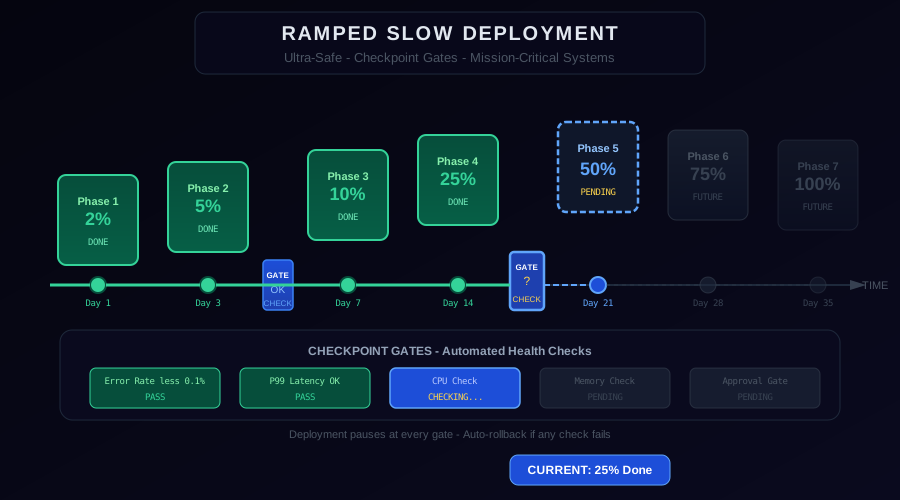
Some systems cannot tolerate a fast rollout. Financial transaction processors, medical device software, and core banking platforms operate in environments where a 30-minute deployment is considered fast. For these systems, ramped slow deployment exists: a deliberate, checkpoint-driven approach that prioritizes safety over speed.
What Is Ramped Slow Deployment?
Ramped slow deployment is a variant of the ramped strategy with two critical additions: extended soak times at each percentage gate and explicit approval gates before advancing to the next stage.
Where a standard ramped deployment spends 5-10 minutes at each stage, a ramped slow deployment spends hours or days.
| Stage | Traffic % | Soak Time | Gate |
|---|---|---|---|
| 1 | 2% | 24 hours | Automated health check |
| 2 | 5% | 24 hours | Automated and manual review |
| 3 | 10% | 48 hours | CAB approval |
| 4 | 25% | 48 hours | Director sign-off |
| 5 | 50% | 72 hours | Executive review |
| 6 | 100% | Complete | — |
A single deployment can span two weeks. That is by design.
Who Needs This Strategy?
Financial institutions — Core banking systems process millions of transactions daily. A regression in interest calculation or currency conversion can cause cascading errors that are extremely difficult to unwind.
Healthcare systems — Clinical decision support tools operate under FDA and HIPAA requirements that mandate change control processes with documented approvals.
E-commerce at scale: At high checkout volumes, even a small failure rate can cause substantial lost revenue.
The Checkpoint Gate Pattern
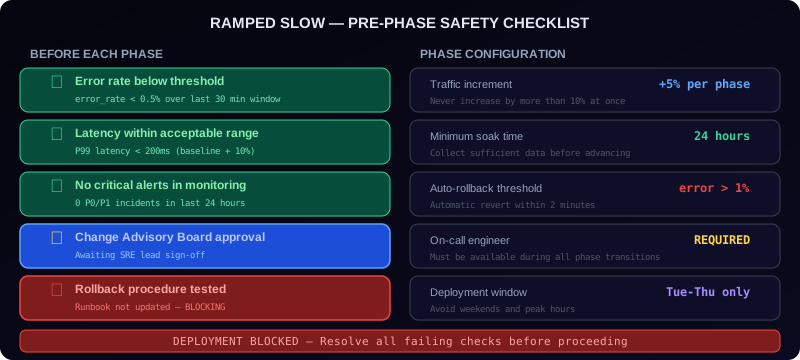
Each stage transition has an explicit gate that must pass before proceeding.
Automated checks: error rate below baseline plus 0.5% for the full soak period, P99 latency not increased more than 10%, no new error classes in application logs, all dependent services healthy.
Manual checks: engineering lead has reviewed monitoring dashboards, customer support ticket volume unchanged, business metrics within 2% of baseline, Change Advisory Board has signed off.
Kubernetes Implementation
Argo Rollouts supports indefinite pauses requiring explicit human approval to advance.
apiVersion: argoproj.io/v1alpha1
kind: Rollout
metadata:
name: banking-core
namespace: production
spec:
replicas: 100
strategy:
canary:
steps:
- setWeight: 2
- pause: {duration: 24h}
- setWeight: 5
- pause: {}
- setWeight: 10
- pause: {duration: 48h}
- setWeight: 25
- pause: {}
- setWeight: 50
- pause: {duration: 72h}
- setWeight: 100
analysis:
templates:
- templateName: error-rate-check
startingStep: 1
Approve a manual pause:
kubectl argo rollouts promote banking-core -n production
Automatic Rollback
Manual review is for validation but automated systems must catch catastrophic failures immediately.
apiVersion: argoproj.io/v1alpha1
kind: AnalysisTemplate
metadata:
name: error-rate-check
spec:
metrics:
- name: error-rate
interval: 5m
count: 288
successCondition: result[0] < 0.005
failureLimit: 3
provider:
prometheus:
address: http://prometheus:9090
query: |
sum(rate(http_requests_total{
job="banking-core",status=~"5.."
}[5m])) /
sum(rate(http_requests_total{job="banking-core"}[5m]))
Three consecutive failures trigger automatic rollback regardless of approval state.
Deployment Record Format
deployment_id: "DEPLOY-2026-11-12-001"
service: "banking-core"
version: "v3.4.2"
stages:
- percentage: 2
end_time: "2026-11-13T09:00:00Z"
error_rate: 0.0012
p99_latency_ms: 142
approved_by: "auto"
- percentage: 5
end_time: "2026-11-14T09:00:00Z"
error_rate: 0.0014
p99_latency_ms: 148
approved_by: "alice@example.com"
When Not to Use This Strategy
Ramped slow deployment has real costs. A two-week deployment means maintaining a split-version environment throughout that period — hotfixes must be applied to both versions, debugging is more complex, and new features that break backwards compatibility must wait. For most SaaS applications without regulatory requirements, this overhead is excessive.
Use it only when the cost of a production incident genuinely exceeds the operational cost of the extended rollout.
Conclusion
Ramped slow deployment is the right choice when failure is not an option and the organization accepts the overhead of a deliberate, multi-day release process. By combining extended soak times, explicit approval gates, automated metric validation, and audit-ready deployment records, it delivers a level of release safety that no other strategy matches.
Related: Enterprise Ramped Slow Best Practices | Ramped Deployment for Standard Services | For services where a faster ramp is acceptable, canary deployment offers a good balance of safety and speed.
From the team at Nife
Deploy your next app in minutes, not days.
Nife is a multi-cloud edge platform that lets you deploy, scale, and manage applications globally without the infrastructure headache.